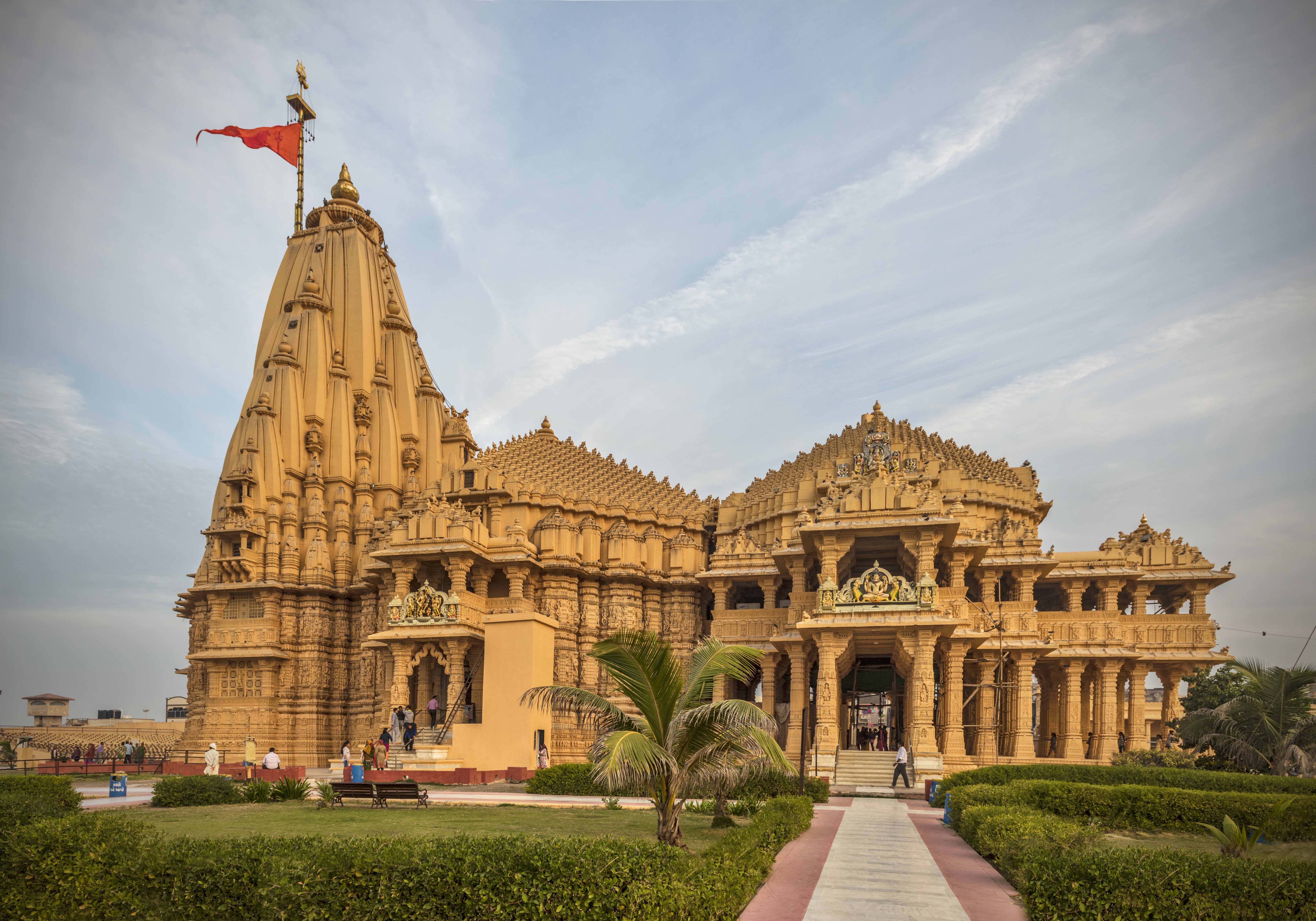
There are places you visit to admire their beauty. There are places you visit to learn about history. And then there are places like Somnath, where history, spirituality, mythology, architecture, and nature come together to create an experience that stays with you long after your journey ends.
Standing proudly on the western coast of Gujarat, where the endless waves of the Arabian Sea embrace India's shoreline, Somnath Jyotirlinga has inspired devotion for thousands of years. It is traditionally regarded as the first of the twelve Jyotirlingas of Lord Shiva and remains one of the most sacred pilgrimage destinations in Hinduism.
For millions of devotees, Somnath is much more than a temple. It is a place of hope, gratitude, and inner peace. Every sunrise over the Arabian Sea, every ringing temple bell, every chant of "Har Har Mahadev" reminds visitors that faith can endure every challenge.
The story of Somnath is extraordinary. Over centuries, the temple has witnessed prosperity, invasions, reconstruction, and renewal. Despite these challenges, devotion never faded. The temple that stands today is not merely a magnificent architectural landmark—it is a living symbol of resilience and India's spiritual heritage.
Whether you are planning your first pilgrimage, travelling with family, completing the sacred Jyotirlinga Yatra, or simply exploring Gujarat's cultural treasures, this guide has been designed to help you experience Somnath in the most meaningful way possible.
| InformationDetails | |
| Temple Name | Somnath Jyotirlinga |
| Popular Name | Somnath Mahadev Temple |
| Location | Prabhas Patan, Gir Somnath District, Gujarat |
| Presiding Deity | Lord Shiva |
| Religious Importance | First of the Twelve Jyotirlingas |
| Temple Style | Chalukya Architecture |
| Best Time to Visit | October to March |
| Ideal Trip Duration | 2 Days |
| Nearest Airport | Diu Airport |
| Nearest Railway Station | Somnath Railway Station |
| Main Festival | Mahashivratri |
| Suitable For | Families, Pilgrims, Senior Citizens, Solo Travellers |
Most travel articles tell you what to see.
This guide helps you understand:
Our goal is simple: after reading this guide, you should be able to plan your entire Somnath journey without searching multiple websites.
| TopicRecommendation | |
| Ideal Trip Duration | 2 Days |
| Best Season | October – March |
| Temple Visit | Early Morning or Evening |
| Family Friendly | ✔ Yes |
| Senior Citizen Friendly | ✔ Yes |
| Photography | Restricted inside the main temple |
| Parking | Available near the temple |
| Local Language | Gujarati, Hindi |
| Best Time for Photography | Sunrise & Sunset |
| Ideal Budget | Budget, Mid-range and Premium options available |
Every pilgrim has a different reason for visiting Somnath.
Some arrive seeking Lord Shiva's blessings before beginning a new chapter in life. Others come to fulfil a long-held spiritual wish. Many families visit together as part of a tradition passed down through generations.
For history enthusiasts, Somnath represents one of India's most remarkable stories of perseverance.
For architecture lovers, it showcases the elegance of traditional temple craftsmanship.
For photographers, the temple's location overlooking the Arabian Sea offers unforgettable views, especially during sunrise and sunset.
For travellers, Somnath is the perfect combination of spirituality, history, culture, and natural beauty.
Few places in India offer such a complete experience.
Among thousands of Shiva temples across India, Somnath holds a special place.
According to Hindu tradition, Somnath is the first among the twelve Jyotirlingas, making it one of the most sacred shrines dedicated to Lord Shiva.
Throughout history, the temple has been rebuilt multiple times after periods of destruction. Its continued existence reflects the enduring faith of generations of devotees.
Unlike most pilgrimage sites, Somnath stands dramatically on the coastline. The sound of crashing waves alongside temple bells creates a unique spiritual atmosphere.
Visitors come not only for worship but also to appreciate the temple's architecture, history, nearby sacred sites, museums, and coastal landscape.
If you are planning a pilgrimage to any of the twelve Jyotirlingas, the answer is undoubtedly yes.
Even if you are not travelling for religious reasons, Somnath offers:
For many visitors, the journey to Somnath becomes one of the most meaningful experiences of their travels in Gujarat.
Somnath is suitable for almost every type of traveller.
Complete your Jyotirlinga Yatra or seek Lord Shiva's blessings in one of Hinduism's holiest shrines.
The destination offers comfortable accommodation, good road connectivity, and nearby attractions suitable for all ages.
Pleasant weather during winter and accessible travel options make Somnath a popular pilgrimage destination for senior travellers.
The town is welcoming, easy to navigate, and ideal for spiritual reflection.
The temple's remarkable story and architectural style make it an important cultural landmark.
Every sacred temple has a story. Some are rooted in history, while others are woven into mythology and faith. The story of Somnath Jyotirlinga is one such timeless legend that has been narrated for centuries and continues to inspire millions of devotees.
The name "Somnath" is derived from two Sanskrit words:
Together, Somnath means "The Lord of the Moon."
But why did Lord Shiva receive this name?
To understand this, we must travel back to an ancient era when gods, sages, and celestial beings shaped the spiritual traditions that continue to influence Hindu culture today.
According to Hindu scriptures, Daksha Prajapati, one of the sons of Lord Brahma, had twenty-seven daughters. These daughters represented the 27 Nakshatras (lunar constellations) used in Vedic astrology.
Daksha arranged the marriage of all twenty-seven daughters to Chandra Dev (the Moon God).
The expectation was simple.
Chandra would treat every wife equally and spend equal time with each of them.
Initially, everything seemed harmonious.
However, over time, Chandra developed a deep affection for Rohini, one of his wives.
Instead of spending equal time with all twenty-seven queens, he began staying almost exclusively with Rohini.
The remaining daughters felt neglected and deeply hurt.
Unable to bear this unfair treatment, they approached their father, Daksha, and shared their sorrow.
Daksha summoned Chandra and advised him to fulfil his responsibilities equally.
He reminded him that a ruler's personal preferences should never outweigh justice and fairness.
Chandra listened respectfully but ignored the advice.
His affection for Rohini only grew stronger.
The neglected queens returned to Daksha once again.
This time, Daksha was no longer willing to overlook Chandra's behaviour.
Filled with disappointment, Daksha pronounced a powerful curse upon Chandra.
He declared that the Moon God would gradually lose his brilliance, beauty, and strength.
Slowly, Chandra's radiant glow began to fade.
The once-luminous Moon became weak and pale.
As the Moon weakened, its effects spread across the universe.
Nature itself began to suffer.
Plants struggled to grow.
Medicinal herbs lost their vitality.
The balance of time and seasons was disturbed.
The gods became concerned.
Realising the consequences of his actions, Chandra sought forgiveness.
He approached many gods and sages, hoping someone could remove Daksha's curse.
However, no one possessed the authority to reverse it completely.
Finally, the sages advised Chandra to seek refuge in Lord Shiva, the compassionate protector of all beings.
They instructed him to travel to the sacred land of Prabhas Kshetra, where he should perform intense penance with complete devotion.
Chandra reached the peaceful shores of Prabhas.
There, he began deep meditation.
Days became months.
Months became years.
He remained completely devoted to Lord Shiva, chanting sacred mantras and offering heartfelt prayers.
His unwavering faith eventually pleased Lord Shiva.
The divine energy of the Lord manifested before Chandra.
When Shiva appeared, Chandra humbly admitted his mistake and asked for forgiveness.
Lord Shiva, known as Ashutosh—the one who is easily pleased by sincere devotion—accepted his prayers.
However, Shiva also respected Daksha's authority.
Instead of removing the curse entirely, Lord Shiva transformed it into a blessing.
He declared:
This divine arrangement gave birth to the natural cycle of the waxing and waning of the Moon, a phenomenon still observed every month.
Because Lord Shiva restored the Moon's radiance, devotees began worshipping Him here as Somnath—the Lord of the Moon.
According to tradition, after blessing Chandra, Lord Shiva manifested Himself at Prabhas Kshetra as a radiant column of divine light—a Jyotirlinga.
This sacred manifestation became known as Somnath Jyotirlinga.
For countless generations, devotees have believed that worshipping Lord Shiva here brings peace, strength, wisdom, and spiritual fulfilment.
Beyond mythology, this story carries timeless life lessons.
Chandra's suffering began because he failed to treat everyone fairly.
The story reminds us that responsibility and balance are essential in life.
Even after making mistakes, Chandra never lost hope.
Through humility and sincere devotion, he found redemption.
Shiva did not ignore justice, nor did He refuse mercy.
Instead, He transformed punishment into an opportunity for growth.
This balance between compassion and responsibility is one of the deepest messages of the Somnath legend.
Many pilgrims believe that Somnath is a place where burdens become lighter.
People visit with prayers for:
Whether these blessings are viewed through faith, personal reflection, or tradition, countless visitors describe leaving Somnath with a renewed sense of calm and purpose.
Today, every prayer offered at Somnath carries forward a tradition that has endured for centuries.
When devotees stand before the Jyotirlinga, they remember not only Lord Shiva's greatness but also the timeless lesson that no mistake is beyond redemption when accompanied by humility, faith, and sincere effort.
The legend of Chandra and Lord Shiva is more than mythology—it is a reminder that even after life's darkest phase, light can return, just as the Moon regains its brilliance every month.
The history of Somnath Temple is unlike that of any other temple in India. It is a story of faith, prosperity, destruction, reconstruction, and unwavering devotion. For devotees, Somnath is a sacred shrine of Lord Shiva. For historians, it is one of India's most remarkable examples of cultural continuity.
Over thousands of years, rulers changed, kingdoms rose and fell, and empires came and went. Yet Somnath remained a place of worship and pilgrimage. Every time the temple suffered damage, it was rebuilt by those who believed that faith could not be destroyed.
Today, Somnath stands as a symbol of resilience and spiritual strength, welcoming millions of visitors each year.
The sacredness of Somnath is deeply rooted in Hindu tradition. The temple and the holy region of Prabhas Kshetra are mentioned in several ancient texts, including the Skanda Purana, Shiva Purana, and other traditional religious literature.
These references describe Prabhas as a sacred land where devotees worshipped Lord Shiva and where Chandra Dev performed penance to seek freedom from Daksha's curse.
For centuries, saints, sages, and pilgrims have regarded Somnath as one of the holiest places dedicated to Lord Shiva.
Because of its religious importance and its location near the western coast of India, Somnath gradually became a thriving pilgrimage destination.
Pilgrims from different regions visited the temple to offer prayers and donations. Over time, the temple became renowned not only for its spiritual significance but also for its prosperity.
Historical accounts describe Somnath as one of the most respected temples of its time, attracting devotees, scholars, merchants, and travellers from across the Indian subcontinent.
One of the defining characteristics of Somnath Temple is that it has been rebuilt several times over the centuries.
Rather than focusing only on episodes of conflict, it is equally important to recognize the determination of generations who restored the temple and preserved its spiritual importance.
Every reconstruction reflected the devotion of communities who believed that sacred places should continue to inspire future generations.
This enduring cycle of renewal is one of the reasons Somnath occupies such an important place in India's cultural memory.
After India gained independence, efforts were made to rebuild Somnath Temple once again.
The present temple was constructed in the Chalukya style of temple architecture, inspired by traditional Indian design principles.
Built using sandstone and traditional craftsmanship, the temple combines grandeur with simplicity. Its soaring shikhara, intricately carved walls, and commanding position beside the Arabian Sea make it one of the most impressive temples in India.
Today, the temple is managed to accommodate large numbers of pilgrims while preserving its religious character.
Although Somnath is primarily known for its spiritual significance, its architecture deserves equal admiration.
Some of the most striking features include:
The temple's design reflects classical Indian architectural traditions while allowing visitors to experience both spirituality and natural beauty.
One of the most photographed landmarks within the temple complex is the Baan Stambh, also known as the Arrow Pillar.
An inscription at the site explains that the pillar points directly south across the Arabian Sea toward Antarctica, with no landmass in between along that line. This unique geographical feature has become one of the temple's most interesting talking points for visitors.
Whether viewed as a geographical marker or a symbol of India's ancient maritime awareness, the Baan Stambh adds another fascinating dimension to the Somnath experience.
Modern Somnath is more than a pilgrimage destination.
It is also:
Visitors often combine their temple visit with nearby attractions such as Triveni Sangam, Bhalka Tirth, Dehotsarg Tirth, and Somnath Beach, making it an ideal destination for a one- or two-day trip.
Many historic monuments are admired for their age.
Many temples are admired for their religious importance.
Somnath is admired for both—and for something more.
Its greatest legacy is the faith of countless devotees who ensured that worship continued across generations.
For pilgrims, Somnath represents hope.
For historians, it represents continuity.
For travellers, it offers an unforgettable blend of spirituality, heritage, and coastal beauty.
In this chapter, we explored:
After understanding the history and mythology of Somnath Jyotirlinga, it's time to plan your visit. A well-planned pilgrimage allows you to spend more time experiencing the temple and less time worrying about logistics.
Whether you are visiting for a few hours or staying for a couple of days, knowing the temple timings, visitor guidelines, and available facilities will make your journey smoother and more enjoyable.
Somnath Temple remains open throughout the year and welcomes devotees every day.
| ActivityTimings* | |
| Temple Opens | 6:00 AM |
| Temple Closes | 9:30 PM |
| General Darshan | Throughout the Day |
| Morning Aarti | Around 7:00 AM |
| Midday Aarti | Around 12:00 Noon |
| Evening Aarti | Around 7:00 PM |
Note: Timings may change during festivals, special religious events, or due to temple administration decisions. Visitors should verify the latest schedule before travelling.
Although the temple remains open throughout the day, the overall experience varies depending on the time you visit.
This is considered one of the best times for darshan.
Advantages:
Recommended for:
Crowds are generally moderate on normal weekdays.
During summer, afternoons can be warm, so carrying drinking water is advisable.
The atmosphere changes completely during the evening.
As sunset approaches over the Arabian Sea, thousands of devotees gather for the evening aarti.
After the aarti, many visitors stay back to enjoy the famous Sound and Light Show.
A visit to Somnath Temple is much more than standing in a queue. It is a journey through a sacred space that has welcomed devotees for centuries.
A typical visit follows this sequence:
Many visitors describe the experience as peaceful and well organized, especially on regular weekdays.
For the safety of all visitors, security arrangements are in place.
Before entering:
Security procedures may become more extensive during festivals and national holidays.
Visitors should note that restrictions may apply to mobile phones and certain electronic devices inside the temple premises.
Depending on the prevailing guidelines:
Always follow the latest instructions issued by temple authorities.
Many visitors wish to capture memories of their trip.
Generally:
Excellent photography opportunities are available outside the temple, especially during sunrise and sunset.
Although there is no elaborate mandatory dress code for general visitors, modest and respectful clothing is strongly recommended.
Comfortable footwear is recommended, although shoes must be removed before entering designated temple areas.
The temple complex is designed to accommodate a large number of devotees comfortably.
Facilities available in and around the complex may include:
Availability of specific facilities may vary, especially during renovation work or major festivals.
Somnath Temple is visited by people of all age groups.
Senior citizens and visitors with mobility concerns are encouraged to:
Families travelling with young children should keep drinking water and light snacks handy during warmer months.
Among all temple rituals, the evening aarti is one of the most memorable.
As lamps illuminate the temple and devotional hymns fill the air, devotees gather to offer prayers to Lord Shiva.
The atmosphere becomes especially serene as the sound of temple bells blends with the waves of the Arabian Sea.
For many visitors, attending the evening aarti becomes the highlight of their Somnath pilgrimage.
After sunset, visitors can enjoy the popular Sound and Light Show.
The presentation narrates:
If you are staying overnight, this experience is highly recommended.
Ideal for travellers continuing their journey the same day.
Ideal for visitors staying overnight.
Before leaving for the temple, make sure you have:
✔ Valid ID (if required)
✔ Comfortable clothing
✔ Drinking water
✔ Essential medicines
✔ Cash or digital payment options for local purchases
✔ A cap or umbrella during summer
✔ Your accommodation details if staying overnight
One of the biggest advantages of visiting Somnath is its excellent connectivity. Whether you're travelling from Gujarat or another part of India, you can reach Somnath conveniently by air, train, or road.
This chapter will help you choose the best travel option based on your starting point, budget, and available time.
Somnath Temple is located in Prabhas Patan, a historic town in the Gir Somnath district of Gujarat, on the western coast of India.
The temple overlooks the Arabian Sea and is well connected to major cities across Gujarat.
| CityApproximate DistanceTravel Time | ||
| Veraval | 7 km | 15–20 minutes |
| Diu | 85 km | 2 hours |
| Junagadh | 95 km | 2–2.5 hours |
| Rajkot | 200 km | 4–5 hours |
| Dwarka | 235 km | 5 hours |
| Ahmedabad | 410 km | 7–8 hours |
| Vadodara | 540 km | 9–10 hours |
| Surat | 650 km | 11–12 hours |
Travel times are approximate and may vary depending on traffic and road conditions.
Although Somnath does not have its own commercial airport, several nearby airports provide convenient access.
Diu Airport is the closest airport to Somnath.
Approximate distance:
80–90 km
From the airport you can reach Somnath by:
Travel Time:
Approximately 2 hours.
Rajkot serves travellers arriving from several Indian cities.
From Rajkot you can continue your journey by:
Approximate travel time:
4–5 hours by road.
Ahmedabad is the largest and best-connected airport in Gujarat.
It is suitable for visitors travelling from:
From Ahmedabad you can continue to Somnath by train, private cab, or bus.
| AirportBest For | |
| Diu | Shortest road journey |
| Rajkot | Regional connectivity |
| Ahmedabad | Maximum flight options |
Rail travel is one of the most popular ways to visit Somnath.
The town has its own railway station located close to the temple.
From the station:
are easily available.
Veraval Junction is another important railway station serving the region.
Many visitors arriving at Veraval continue to Somnath by road in approximately 15–20 minutes.
Road travel offers flexibility and allows visitors to explore other destinations in Gujarat along the way.
Well-maintained highways connect Somnath with several important cities.
Regular buses and taxis operate from:
Many families prefer driving to Somnath.
Advantages include:
Before starting your trip:
State transport buses connect Somnath with several cities across Gujarat.
They are an economical option for budget travellers and pilgrims.
Private bus operators also provide regular services on popular routes.
Once you reach Somnath, getting around is simple.
Available transport options include:
Many important places are located within a short distance of the temple.
Visitors arriving by private vehicle will find designated parking areas near the temple.
Tips:
Ideal for visitors arriving by flight.
Suggested plan:
Ahmedabad → Somnath → Dwarka (optional) → Return
Many pilgrims combine these two important pilgrimage destinations in one journey.
Approximate travel time:
5 hours by road.
This is one of the most scenic routes.
Visitors often combine:
into a two- or three-day trip.
Families travelling with children should:
Booking accommodation close to the temple reduces unnecessary local travel.
For senior travellers:
If visiting during:
expect:
Advance travel and accommodation planning is strongly recommended.
Many visitors include Somnath as part of a larger Gujarat itinerary.
Popular combinations include:
Before starting your journey:
✔ Confirm train or flight tickets.
✔ Reserve accommodation in advance.
✔ Check local weather.
✔ Carry identification documents.
✔ Keep digital payment options available.
✔ Save emergency contact numbers.
✔ Keep your phone charged and carry a power bank.
A pilgrimage to Somnath does not end with darshan at the Jyotirlinga. The region around the temple is rich in history, mythology, spirituality, and natural beauty. Many of these places are closely connected with episodes from Hindu scriptures, especially those associated with Lord Krishna and the ancient city of Prabhas.
If you are planning a one-day or two-day trip, these attractions deserve a place in your itinerary.
Distance from Somnath Temple: Approximately 1 km
Recommended Visit Duration: 30–45 Minutes
Triveni Sangam is one of the most sacred places in Somnath. It is traditionally believed to be the confluence of three rivers—Hiran, Kapila, and the mystical Saraswati.
For centuries, pilgrims have visited this holy confluence before or after offering prayers at Somnath Temple. Many devotees believe that taking a holy dip here symbolizes spiritual purification before seeking the blessings of Lord Shiva.
The peaceful surroundings also make it an ideal place for meditation and quiet reflection.
Early morning.
Distance: Approximately 5 km
Recommended Visit Duration: 45–60 Minutes
Bhalka Tirth is one of the most revered sites associated with Lord Krishna.
According to Hindu tradition, this is the place where Lord Krishna was struck by an arrow while resting beneath a tree. This event marked the beginning of the conclusion of His earthly life.
Today, the temple and surrounding complex attract devotees from across India who wish to pay their respects and learn about this significant episode.
Distance: Approximately 2 km
Recommended Visit Duration: 30–45 Minutes
Located near the banks of the Hiran River, Dehotsarg Tirth is traditionally associated with the final earthly moments of Lord Krishna.
Many pilgrims visit this sacred place after Bhalka Tirth, as the two locations are closely connected in Hindu tradition.
The tranquil environment makes it an excellent place for prayer and contemplation.
Distance: Approximately 2 km
Recommended Visit Duration: 30 Minutes
Built by the Birla family, Gita Mandir is dedicated to the teachings of the Bhagavad Gita.
Verses from the Gita are engraved on the temple walls, allowing visitors to read and reflect upon Lord Krishna's timeless message.
The temple is known for its clean surroundings, beautiful architecture, and peaceful atmosphere.
Distance: Walking distance from the temple
Recommended Visit Duration: 45–60 Minutes
One of Somnath's greatest attractions is its stunning coastline.
After visiting the temple, many travellers enjoy spending time on Somnath Beach, especially during sunset when the Arabian Sea creates a spectacular backdrop.
Although the beach is beautiful, visitors should exercise caution near the water and follow local safety instructions.
Distance: Approximately 1 km
Recommended Visit Duration: 45 Minutes
History lovers should not miss the Prabhas Patan Museum.
The museum houses:
It offers valuable insight into the rich cultural heritage of Somnath and surrounding areas.
Located a short distance from the main temple, Panch Pandav Gufa is associated with the Pandavas from the Mahabharata.
According to local tradition, the Pandavas stayed here during their period of exile.
The site offers a peaceful environment and is worth visiting for those interested in mythology.
Dedicated to the Sun God, Suraj Mandir is one of the lesser-known yet historically significant temples in the area.
Visitors interested in ancient temple architecture often include it in their sightseeing itinerary.
Browse admin-verified guest houses with honest prices and a real host on the other end.
Find a stay →Somnath Jyotirlinga, located in Prabhas Patan, Gir Somnath district of Gujarat, is revered as the first among the twe...
Baidyanath Jyotirlinga, popularly known as Baba Baidyanath Dham, is one of the twelve sacred Jyotirlingas of Lord Shi...
Ujjain's Mahakaleshwar is one of the few Dakshinamukhi (south-facing) Jyotirlingas, and is known across India for its...